Professional and Advisory Work

AI workflow automation for legal teams working under real confidentiality constraints.

Track active matters, monitor trusted sources, draft internal work product, and keep sensitive context inside governed workspaces with audit trails, clearance controls, and IT-managed data connections.

4
firm types
4
role lenses
6
proof surfaces
Industry signals
Support litigation, transactional, regulatory, and in-house teams with cited research, matter-specific drafting, and need-to-know access controls.
Operating theme: Cited research, confidential drafting, matter-level controls.
Matter monitoring and cited briefings: Automations monitor approved sources, generate deltas, and publish concise reports for attorneys and practice leads.
Confidential drafting with internal grounding: Project-linked documents ground editor workflows while teams preserve need-to-know access for sensitive work.
Visual proof panel

A buyer-facing workflow preview for legal teams

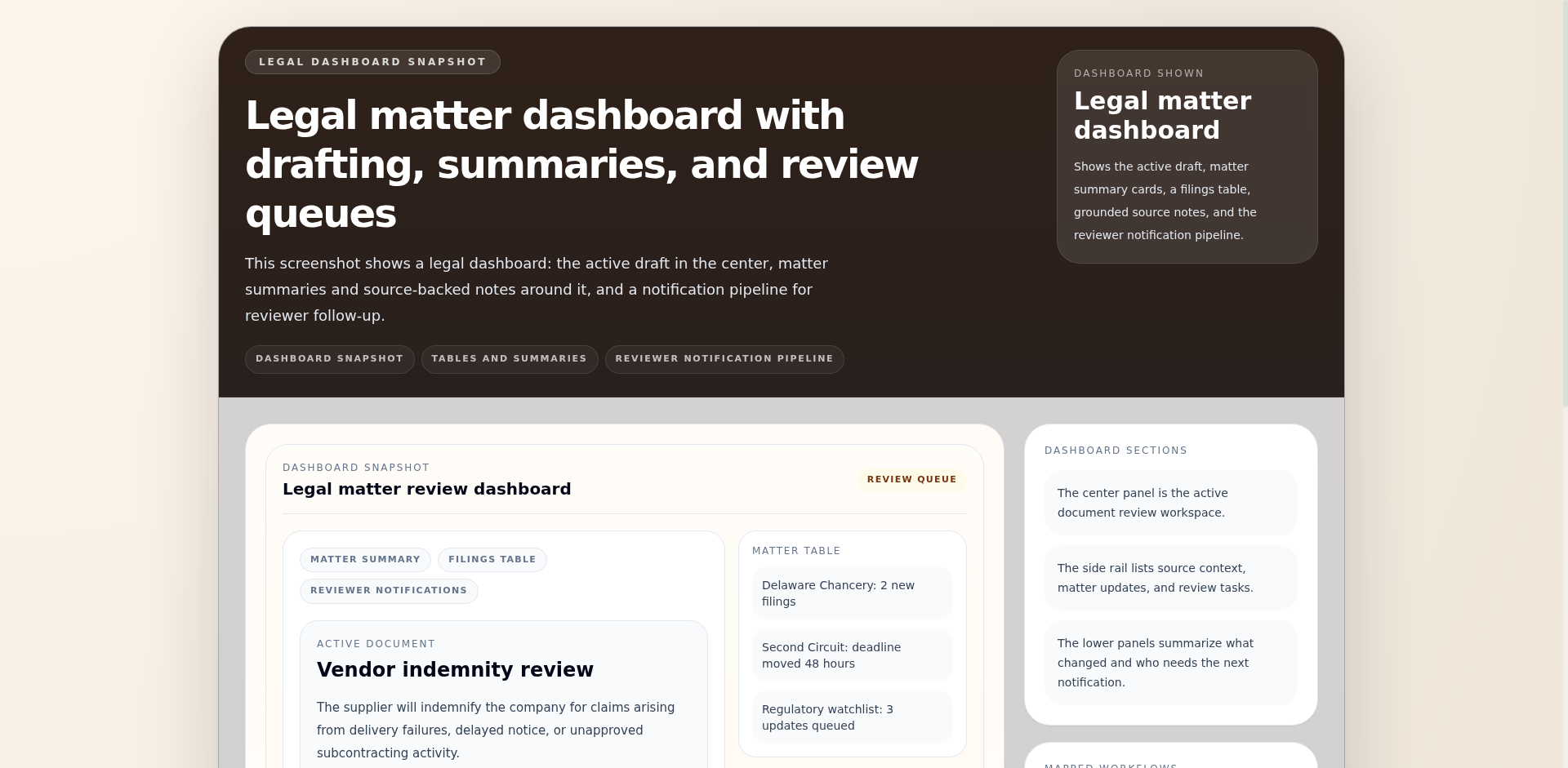
A legal dashboard showing the active draft, matter summaries, a filings table, and the reviewer notification pipeline.

Matters monitored24
New filings7
Cited summaries12
Legal workflow preview
Legal dashboard with drafting, summaries, and review queues
Snapshot
Legal dashboard screenshot showing document review, matter summaries, a filings table, and reviewer notifications.
Workflow signals
Delaware Chancery
Reviewed
2 new filings
Second Circuit appeal
Escalated
briefing deadline shifted
Regulatory watchlist
Queued
3 source updates
Matters monitored
24
New filings
7
Cited summaries
12
Snapshot description
Legal dashboard screenshot showing document review, matter summaries, a filings table, and reviewer notifications.
Dashboard summary: Audit-ready matter summaries, source tracking, and reviewer notifications in one legal dashboard.
Who this is for

Firm types and operating models

Litigation firms and trial teams

Track active matters, filings, and opposing-party developments without forcing attorneys or support staff into repetitive manual monitoring.

Primary buyers: Practice leaders, partners, litigation support, and paralegals.
Workflow focus: Matter monitoring, chronology summaries, and cited research packets.
Corporate and transactional firms

Support faster drafting, clause comparison, and internal precedent reuse across deal teams working with sensitive documents.

Primary buyers: Transactional attorneys, knowledge teams, and legal ops leads.
Workflow focus: Confidential drafting, diligence summaries, and reusable internal language banks.
Regulatory, compliance, and investigations practices

Give teams a governed way to monitor regulatory updates, preserve evidence trails, and coordinate sensitive internal work.

Primary buyers: Regulatory counsel, investigations leads, and compliance managers.
Workflow focus: Approved-source monitoring, defensible summaries, and access-controlled collaboration.
In-house legal departments

Bring legal reporting, contract work, and internal knowledge use under enterprise controls instead of disconnected tools.

Primary buyers: General counsel, deputy GC, legal ops, and IT or security.
Workflow focus: Executive-ready risk summaries, connected legal workflows, and centralized governance.
Role-based value

Different roles, one governed operating layer

Partners and senior attorneys

Receive concise, cited updates on matters, precedent, filings, and issue tracking before strategy decisions.

Controls that matter: Trusted-source restrictions, audit-ready outputs, and matter-level confidentiality.
Paralegals and litigation support

Build chronology summaries, research packets, and reusable matter workspaces without repetitive manual monitoring.

Controls that matter: Project-scoped documents, controlled access, and workflow evidence trails.
Legal ops and knowledge teams

Standardize templates, internal knowledge reuse, and recurring research workflows across matters and practice groups.

Controls that matter: Audit systems, role controls, and compartment-aware collaboration.
IT, security, and governance

Connect approved systems, enforce access boundaries, and choose trusted providers for legal AI workflows.

Controls that matter: Domain allowlists, clearance controls, dedicated deployment, and admin-managed datasource connections.
Core use cases

Workflows mapped to real product surfaces

Matter monitoring and cited briefings

Track case movement, opposing-party developments, and regulatory changes with scheduled automations and evidence-backed summaries.

Workflow: Automations monitor approved sources, generate deltas, and publish concise reports for attorneys and practice leads.
Elis tools and proof
AutomationsTrusted-source searchCitationsAudit log
Confidential drafting with internal grounding

Draft agreements, internal memos, and client-ready updates using approved matter documents and reusable internal knowledge.

Workflow: Project-linked documents ground editor workflows while teams preserve need-to-know access for sensitive work.
Elis tools and proof
Document editorUpload documentsProjectsClearance controls
IT-managed legal integrations

Let legal IT teams connect approved apps, databases, and provider accounts while keeping model and access policies centralized.

Workflow: Customer IT selects trusted providers and supported apps, then routes approved legal workflows through governed enterprise controls.
Elis tools and proof
SQL and API connectionsSupported app integrationsBYOK and BYOADomain allowlists
Role-by-role matrix

Jobs-to-be-done, mapped to features and controls

This matrix turns the page strategy into implementation-ready detail, linking each role to the workflow surface, governance posture, proof destination, and conversion angle.

Firm typeRoleJobs-to-be-doneElis featuresControlsProofCTA angle
Litigation firms and trial teamsPartners and lead litigatorsMonitor active matters, review cited briefings, and turn case movement into internal decisions.Automations, trusted-source search, citations, report exports.Audit trails, domain restrictions, matter-level confidentiality.Monitor matters with governed research.
Litigation firms and trial teamsParalegals and litigation supportAssemble chronology summaries, research packets, and reusable matter workspaces.Projects, upload documents, automations, citations.Project-scoped access and workflow evidence.Support case prep without losing control.
Corporate and transactional firmsTransactional attorneysCompare clauses, summarize diligence, and draft client-ready work product.Document editor, uploaded documents, internal grounding.Controlled document access and cited internal workflows.Draft faster with controlled internal grounding.
In-house legal departmentsLegal operations and IT or securityConnect approved systems, standardize reporting, and centralize provider and policy choice.SQL and API connections, supported app integrations, BYOK and BYOA.Clearance controls, allowlists, dedicated deployment, audit systems.Bring legal AI under enterprise control.
Compliance and control options

Governance translated into buyer language

Audit logs, trace visibility, and evidence trails for defensible review.
Clearance-enabled access, classification defaults, and compartment enforcement for need-to-know matter boundaries.
Domain allowlists, internet disablement, and optional no-egress deployment patterns for sensitive workflows.
Dedicated hosting, org-owned credentials, and customer-managed provider choices for enterprise governance.
Product proof links

Real surfaces your team can inspect

Customer IT and platform teams can connect trusted data sources and supported applications while keeping provider choice and governance policies under their control.
What comes next

Extend the same architecture into adjacent industries

The page structure is designed to expand without redesign. Adjacent industries in the same sector can reuse the same firm-type, role, control, and proof-link modules.

Adjacent industries
AccountingConsultingInsuranceGovernment-adjacent advisory

These sectors can inherit the same auditing systems, clearance controls, customer-managed integrations, and proof-driven workflow structure.

Ready to deploy

Bring legal workflows into a governed AI stack.

Start with product exploration, then move into enterprise deployment planning when your team needs stricter boundaries, auditing systems, and managed integrations.